Bruksbo

Bruksbo is situated at the outlet of Åbjørvatn in the Åbjøra watercourse. Fishing for brown trout and arctic char is available at your doorsteps.

Fishing Location Accomodation Price & booking Technical review

Bruksbo summary

  • Three different package combinations
  • Comfortable cabin with 10 beds
  • The perfect combination of easy access and magnificent scenery
Presentation video

Activities

Sea trout and salmon

Fishing licence for approximately 7 kilometres of the Åelva river is included in the price. The salmon and sea trout populations of the Åelva river is one of the best in the region, and this 7km beat holds some of the best fishing spots in the river. The river is ideal for single hand fly fishing and light spin fishing. Some anglers prefer a two-hand fly rod on higher water levels. The fish ladder built in Åelva river in 2000 makes both lake Åbjørvatn and river Åbjøra available to salmon/sea trout, although all salmon/sea trout caught in the lake or Åbjøra river should be released.

River Åelva is a large-bodied river that has relatively large water level variations during the season. The middle water level is recommended to be optimal for salmon fishing. The early season and the late season usually has relatively high water levels, whereas the middle part of the season differs a lot more from year to year. However, in normal conditions, the middle part of the season is usually some of the best fishing in the upper river beat, especially for salmon. For sea trout, usually, August is recommended, whilst the early season has some high-quality salmon- and sea-run char fishing in the lower beat of the river.

A stay at Bruksbo also includes fishing license in the Terråk river which lies a 40min drive from the cabin. The Terråk river runs right through the town of Terråk and is easily accessed from the road or trail. The river holds both large salmon and sea trout. We recommend trying the Terråk river in combination with a trip to the local grocery market.

Trout and arctic char

Lake Åbjørvatn is easily accessed from the cabin. The lake has large shallow areas on its west side and gets deeper towards the east side. On the far side of the lake, by the inlet of the river Åbjøra, there’s a shallow area well suited for fishing from the boat. Traditionally both spin fishing and fly fishing fish well in the lake. If you want to go for the really big fish, try trolling with large lures such as Rapala and Tomic. Fish up to 1.5kg is not unusual and there’s been caught trout over 4kgs in the lake. The average weight is however about 250g and the fish is of good quality. It’s a dense population of arctic char in Åbjørvatn. Although larger specimens do exist the char is usually of a small size.

The fishing right is also valid for several forest and mountain lakes. Some of which are easily accessed and others require some serious hiking. For the experienced hikers, we recommend Nillsfinntjørnin, Kjerringdalstjørna, Flåtjøra, and Skarstadfuglvatnet. Those who just want to catch fish in a lake without hiking for several hours should try Glømmvatna, Hemmingslitjønna, lomlitjønna, austerengtjønna, or Sandsskartjørna. It’s also possible to go fishing in the Terråk area which holds several good lakes ideal for both family fishing or dedicated fly fishermen.

Fishing regulations Åbjøra lake

Season: Åbjørvatn outside net-prohibited zones: Jan 1 – Dec 31
(Signs indicating these zones are posted at the inlet and outlet of the lake)

Quotas:
* Trout: No catch limit
* Sea trout and salmon are protected in Åbjørvatn, Åbjøra, and tributaries.

Regulations:
*
Outside net-prohibited zones: Worms, spoons, spinners, flies, etc. are permitted.
* Within net-prohibited zones: Worm fishing is prohibited.

Fishing regulations Åelva

Åelva = The river from the fjord up to Åbjørvatn

Season:
* Sea trout / Arctic char: June 1 – August 31
* Salmon:
     * Below Horstadfossen: June 1 – June 30
     * Above Horstadfossen: June 15 – July 15

Quotas:
* Salmon: 3 per person / per season. Maximum length: 65 cm.
* Sea trout / Arctic char: 5 fish per season (maximum 2 per day). Maximum length: 65 cm.

Regulations:
Permitted equipment: Spoons, spinners, and flies.
Angler worms and bait are prohibited.

Lead weights (external attachments on lines or hooks, loose or split shot) are prohibited during fishing. Exception: Weighted flies, where the weight is integrated into the permanent body of the fly.

Additionally, only one treble hook per fishing tackle/rod is allowed. Applies to all equipment.

Fishing regulations in the mountains
ChatGPT sa:

Fishing season: All year

Quotas: No specific quotas, but we ask our guests to practice catch and release for all fish above 1 kg. 

Regulations: It is allowed to fish with spoon, spinner, angler worm. Otter board and fishing nets are not allowed unless you have asked and been given specific permission from us


Fishing regulations Terråk river

Season:
* Sea Trout / Arctic Char: June 15 – August 31
* Salmon: June 15 – July 31

Quotas (per person):
*
Sea Trout: 3 (1 fish per day)
* Salmon: Catch & release only

Regulations: Allowed fishing gear includes fly, lure, spinner, and wobbler. All other baits are prohibited. Maximum one treble hook per line allowed. Preferable without barbs.

Max. size sea trout and salmon is 60 cm.  Fishing can continue after quotas are met as long as "catch and release" is practiced.

Hiking and other activities

The area around the cabin is well suited for mountain top hiking, with several spectacular hikes just outside the doorway. Hikes to such as Granbostad mountain, Nova mountain, Glømtind, Nonselv mountain, and Fuglstad mountain are popular choices. In the Bindal area, there are several short and long hikes that we recommend. For nice weather, we recommend Mulingen and Heilhornet, a 30 minute and 45-minute drive from the cabin.

For those who want to spend more time in the area around the cabin, there are lots of small forest lakes and ponds that are well suited for fishing with the kids. Also, the area holds a lot of Bilberry (blueberry) and Cloudberry that you are welcome to harvest as much as you want. Additionally, there are several good spots for chantarelle in the area around the cabin that is well worth a visit if you stay at the cabin in the late summer.

Location

Bruksbo lies 20 meters from the Åbjøra lake, close to where the Åelva river makes its journey to the fjord 20 km further down the water system. Sitting outside the cabin, you almost feel like you have travelled a thousand years back in time, with no city lights or distractions in sight.

When sitting on the porch, you are beautifully overlooking the Åbjøra lake and its surrounding mountains. In the summertime you can find blueberries just outside of the cabin door and if you go for a walk, there are good chances of finding both  mountain cranberries and chantarelles.

Living in Bruksbo is perfect for those who wish for a peaceful getaway where it is possible to drive all the way to the cabin. There are a few cabins in the area, but they will not interfere with your privacy.

Read more about the history of Bruksbo

Accomodation

Buildings

Traditional cabin with a total of 110 m2. Panelled inside, cover boarding outside. 5 double bedrooms, kitchen, living room with large dining table and sofa group. Shed for wood and outhouse. Boathouse by Åbjørvatn.

Facilities

Practical and good standard. Kitchen table for 10 people, sofa, coffe table and chairs in the living room.

Kitchen utensils

Plenty of cutlery, plates, pots and pans for 10 people.

Technical equipment

Running hot and cold water in the kitchen and for the shower, propane fridge/freezer, propane stove/oven and a wood-burning stove. Solar panel with 12 V chargers and small 230V converter for charging phones etc.

Boats

Boat with 5 HP outboard engine in Åbjørvatn.

Floating equipment

4 life jackets for 70-90 kg lie in the boat-house. Other sizes on request.

Check-in and check-out

You have access to the cabin from 14:00 on arrival day and need to check out before 13:00 on departure day.

Situation

About 20 metres from Åbjørvatn with a beautiful view over the lake. About 30 km from Terråk.

Access

By car. Dirt road, suited for normal cars.

Map reference

M711 - series: nr. 1825 II and III.

GPS-Coordinates

Cabin: UTM 7214783-33W 0390387

Organizing

Arrival: Our guests will be recieved at our office at Terråk or Granbostad. This is decided before arrival. Information about the place and the possibilities in the area will be given.

Beds

Made beds on request, must be arranged beforehand. Down quilts and pillows for 10 people. There are plently of toilet paper, stearin candles and waste bags are in the cabin.

Guiding etc.

Hunting/hiking guides and cooking services can be organized.

Distances

Rørvik airport: 110 km
Brønnøysund airport: 130 km
Trondheim airport: 300 km

Net coverage

There is no coverage around the cabin, but on higher locations in the mountains. Some coverage on the road on the top before driving down to Åbjørvatn, and good coverage 10 minutes drive from the cabin.

Living conditions

Bruksbo is one of our largest cabins and has a high standard with solar power and running water. It has an idyllic location and is suitable for up to 10 people. There is a forest road all the way to the cabin.

Buildings

Buildings: Approximately 100 m² including living room, kitchen, five double bedrooms, laundry room with shower, separate outbuilding for firewood and outhouse. Terrace and outdoor fire pit.

Furniture and facilities: Sofa set, long table with 12 seats. Duvets and pillows for 10 people. One of the bedrooms has a stove and can be used as a drying room.

Technical: Powerful solar power system with 12V/230V. LED lighting. Generator. Water pump with pressure tank. Shower. Automatic propane water heater. Propane stove with oven, propane refrigerator.

Equipment and consumables

Boats: One 14" Pioner Active boat with an outboard motor. An extra boat can be arranged upon request. Gasoline and life jackets (70–90 kg) are stored in the boathouse by the parking area. Other sizes must be arranged in advance.

Things you do NOT need to bring: Tableware, cutlery, cups and cookware, toilet paper, paper towels, soap, candles, lamp oil, firewood, propane, and gasoline.

Things you MUST bring: Bed linens or sleeping bag with pillowcase, first aid supplies, GPS, map/compass, food, etc.

 
 
Arrival

Distances: Rørvik Airport: 110 km, Brønnøysund Airport: 130 km, Værnes Airport: 300 km. The nearest grocery store is in Terråk, about 30 km away.

Key handover: The key is located in a code box at the cabin. The code will be provided by our representative. Agree on the time—and, importantly, the meeting place—well in advance of arrival

Directions to the cabin: Enter Åbjørveien 621, 7980 Terråk into your GPS. Turn right about 100 meters before reaching Åbjørvatnet.

Nearest neighbors: Åbjørneset approx. 1 km, Granbostad approx. 5 km.

Norgeskart with cabin location

Paper map: M711 series: 1825 II and III.

We recommend downloading “Avenza Offline Maps.” Set Bindal as the background map. Choose the layer icon, the download icon, and then tap the QR icon to scan the code below. You will then have an offline map on your phone with property boundaries, routes in areas where it’s easy to go the wrong way, as well as the locations of boats, cabins, etc.

Manuell kobling til kartet.

Practical Information

Guests must bring their own bedding or their own sleepingbags and pillowcases.

Our representative will greet you, and provide you with information about the place and its hunting and fishing oppertunities. (more information in the arrival section)

There is no coverage by the cabin itself however you will find some coverage in certaint places in the mountian. You will ahve Telenor coverage after a 10 minute drive from the parking space, and Netcom coverage after a 30 minute drive.

There is usually lots of blueberries, cowberries and cloudberries  in the area. It is also possible to pick mushrooms here in the fall.

Booking

Check availability and book online using the calendar below. If you have any questions, feel free to contact us.

Select days

Orders last from Friday 14:00 to the following Friday 13:00.
For other times, send a request here.

June 2026
M Mon
T Tue
W Wed
T Thu
F Fri
S Sat
S Sun
1
2
3
4
5
6
7
8
9
10
11
12
13
14
15
16
17
18
19
20
21
22
23
24
25
26
27
28
29
30
July 2026
M Mon
T Tue
W Wed
T Thu
F Fri
S Sat
S Sun
1
2
3
4
5
6
7
8
9
10
11
12
13
14
15
16
17
18
19
20
21
22
23
24
25
26
27
28
29
30
31

Information

Addons

Legg til valgfrie addons

Confirm details

Please review your details before confirming.

Dates of stay

Check-in: ikke satt

Checkout: ikke satt

Total: 0 nights

Contact information

_

_

_

Number

0 people

Comment

Thank you for your inquiry!

We have registered your booking/inquiry for the period _ to _.

📅 Check-in: ikke satt

📅 Checkout: ikke satt

🕒 Total: 0 nights

You will receive a separate confirmation when everything is ready.
If you have any questions in the meantime, please feel free to contact us.

Prices

Applies per week (Friday–Friday). The price is valid for 3 people. Additional charge for guests beyond 3.

Salmon fishing early season: 1/6-14/6: Kr.16.000,-

Additional charge of 2800- per person, per week for more than 3 people.

Salmon fishing high season 15/6-30/7: Kr.20.500,-

Additional charge of 3500- per person, per week for more than 3 people.

Sea trout fishing late season 01/8- 15/9: Kr. 16.000,-

Additional charge of 3500 per person, per week for groups larger than 3 people.

In the period 15/8–15/9, exclusive fishing rights for the entire anadromous stretch of the watercourse (Ureidet, Urvoldvatnet, and the upper river) are included in the price.

In the period 15/8–15/9, it is possible to book shorter stays of 3 or 4 days with the following prices (for 3 people):

Friday – Tuesday: 16,500
Tuesday – Friday: 21,900

Contact us by email or phone to book a 3- or 4-day stay in the period 15/8–15/9.

Includes:

Cabin, fishing rights, three boats on Urvoldvatnet (five boats when renting the entire watercourse), firewood, propane, etc.

The price applies for up to 3 people; for more than 3 people, an additional charge of NOK 2800 (June) and 3500 (the rest of the season) per person.

Important information (general/shared)

Before arrival

We recommend familiarizing yourself with the area and what it offers before your arrival
Being well prepared will make your stay far more enjoyable. Our properties are located in the heart of Norway, and even though the calendar may say summer, it can still get cold in the mountains. Be sure to pack warm clothes and sturdy footwear for your comfort.

If you plan to spend time in the mountains, it’s wise to bring a GPS, map, first aid kit, emergency blanket, or similar equipment. Please note that mobile coverage is limited or unavailable in many mountain areas.

Bring your own bed linen and towels unless otherwise agreed.
If the cabin does not have duvets and pillows, please bring a sleeping bag, pillowcase, and fitted sheet.

A few days before your arrival, you will receive a text message with driving directions and other useful information about the cabin.

Fishing advice

Inland fishing

Lures and Spinners:

We recommend classic lures such as Sølvkroken Spesial or Aura Flake, Salamander in copper or red, Panther Martin spinners, or spoon lures like Jensen Pirk in black/silver and Stingsilda in red/black or gold/black. Lures in the 6–12 gram range work well in most situations.
Wobblers such as Rapala Team Esko or Jointed Countdown in color FRHF are proven trout favorites. Wobblers like Bomber and Prey Target also cast and fish extremely well.

From experience, how you fish is just as important as what you fish with. Retrieve irregularly, with short pauses of 1–3 seconds — this often makes the difference between a bite and none at all.
Cover as much water as possible. Start casting to one side and gradually “fish” the entire area in front of you in a fan pattern until you’ve covered everything within reach. If trout are present and feeding, they often strike immediately — so move to a new spot rather than staying too long in one place.

Flyfishing:

You don’t need a large selection of flies — just a few patterns go a long way. When mayflies are hatching, a parachute dry fly in the right size usually does the job. If midges are on the menu, a Griffith’s Gnat or a small black parachute fly works well. Rakkelhane, Streaking Caddis, and Klinkhammer are excellent caddisfly imitations.

The Streaking Caddis is famous for bringing trout to the surface even when there’s no visible rise. Fish it so that it skates or drags across the surface — this often triggers aggressive strikes. It also works perfectly with a float for spin fishermen.

When the water is rougher or there’s no surface activity, fish below the surface. Flies such as Woolly Bugger and Hare’s Ear Nymph have been trusted choices among fly fishers for decades.

Sea trout / salmon fishing

For sea trout and salmon fishing—especially in running water—it’s smart to fish through the area and then take a break. It’s often pointless to keep fishing the same spot continuously if the fish aren’t biting. If you get a strike on your fly or lure on one of the first casts without hooking the fish, and the lure is completely ignored on the next few casts—change your fly or lure and try again. In the Urvold and Eide watersheds, experience shows that brown nylon works better than clear. In the Urvold River there are many sharp rocks, so be cautious using Fireline without a nylon leader. In many places you can manage without waders, but if you have room in your luggage, bring them!

Spinners and lures: For lure fishing, the Buck Spesial 12–18 g gold-silver with Buck’s distinctive red-silver backside is very effective. Fish it with irregular movements. Experiment! A Salmo wobbler can be weighted with three or four split shot so it can be fished with up-and-down motion. When fishing from a boat, varying your speed is crucial. Wikke and Prey casting wobblers are excellent for salmon and sea trout. Møresild and Tasmanian Devil, preferably in green and copper, also work well. In Urvoldvatnet, small silver-colored spoons often produce good results.

Fly fishing: It’s hard to give advice that works in every situation, but try flies such as Heggeli, Sunray Shadow, Green Highlander, and Zonkers in either muted or bright colors.

You can also use tube flies. Our experience is that the combination of green and red works well. If the water is low and the fish are shy, it’s often wise to try small dry flies. Remember a long leader!


Property map

Norgeskart with property boundaries gives you the best map. They also have an app that works offline.

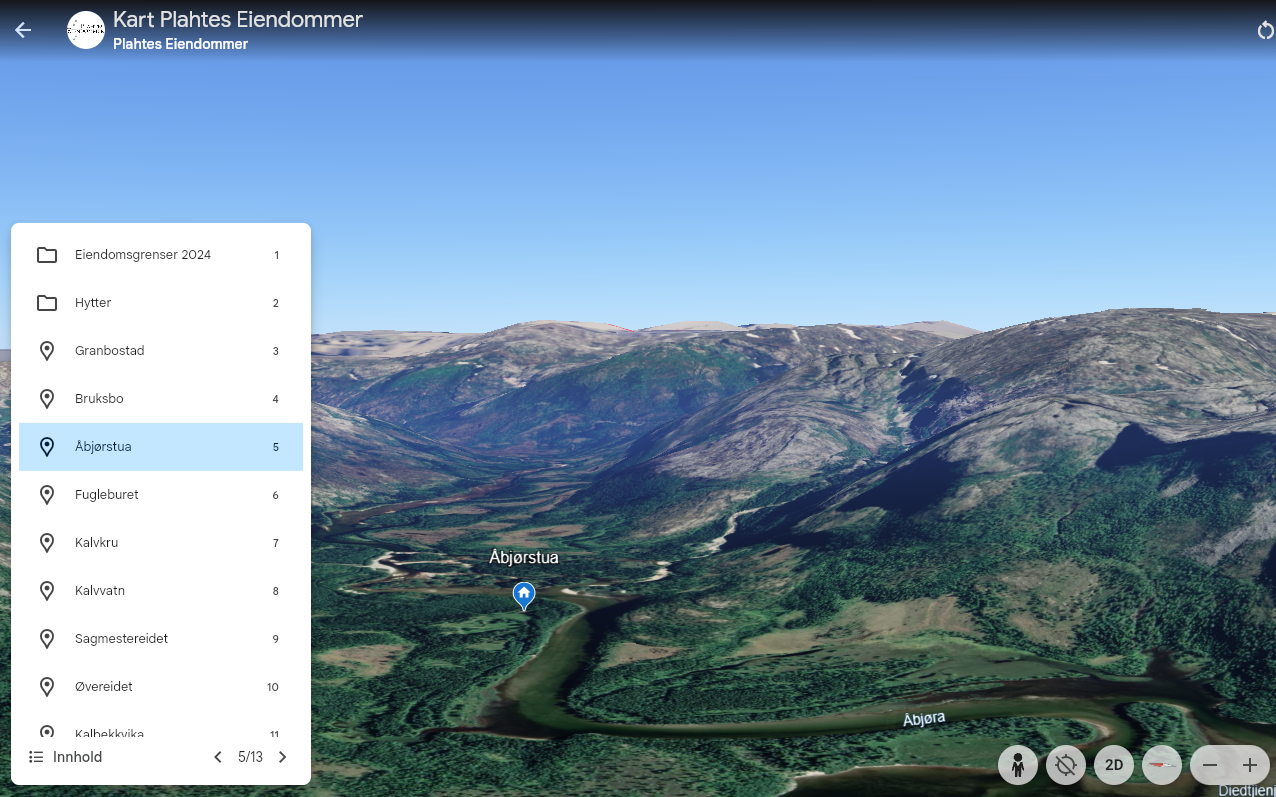
Google Earth with property boundaries, trails, cabins, descriptions of fishing lakes and more. The same map is available in Google Maps (you have to toggle layers on and off to see trails, etc.).

Avenza maps: Offline maps with terrain boundaries, but lower resolution than Norgeskart (N50 with 20-meter contour lines).
1: Install the app. 2: Download this map. 3: Scan this QR code to get terrain boundaries etc.

Boat and outboard motor

The description below is general information about the use of boats and motors and is not relevant for all cabins.

Boats in the mountains are usually made of aluminum and must be flipped over and secured after use unless something else has been agreed upon. Bring a life jacket, and make sure that thwarts and other parts don’t break.

On the larger lakes, Pioner 14 boats with 9.8 hp motors are primarily used.

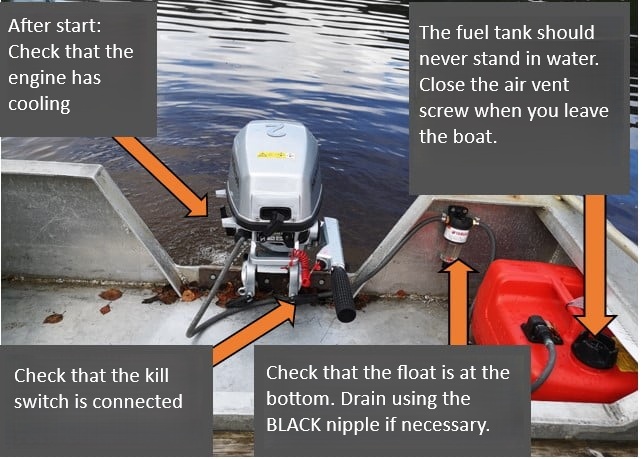
Outboard motors: 90% of all problems with outboard motors are caused by water in the fuel. Do not pour gasoline through a wet funnel.

  1. Put the motor in neutral and the throttle in the start position.
  2. Check that the air vent screw on the tank is open.
  3. Check that the kill switch is in place.
  4. Check that the red float in the water-separating filter is at the bottom of the glass.
  5. Pull the starter cord slowly for the first 10 cm. Don’t pull so hard or far that the cord snaps.
  6. Use the choke only for the first 2–3 pulls. Then a few pulls without the choke. Turn off the choke once the engine has started.
  7. When the engine has started: Make sure the motor has a cooling water stream.

Problems? Then it is most likely water in the gasoline. Check whether the red float in the filter is at the bottom. Drain the filter and see whether water or gasoline comes out.

    • Change the tank. Do not connect it to the motor before you have pumped fresh gasoline through the filter and hose.
      (You need to press the ball on the motor coupling with a small stick to be able to pump fresh gasoline through the hose.)
      Be 100% sure there is no water left in the hose or filter.
    • Drain the carburetor of water by loosening the drain screw and pumping a couple of times
      (use a screwdriver on motors that don’t have a screw you can loosen by hand).
    • Still having problems? Change the motor, but be 100% sure there is no water left in the filter or hose.0
Safety

THIS PAGE MUST BE READ BY ALL PARTICIPANTS

Even though most of our guests are used to traveling in the mountains, it is important to think through safety during your stay at Plahtes Eiendommer. We ask that all participants in the group read this page about safety.

The cabin

Take fire safety seriously: Test the smoke detectors and familiarize yourselves with the location of the fire extinguisher. Be careful with candles and paraffin lamps. Make sure there is enough distance above the flame/lamp, and physically check whether the nearest flammable material is getting too warm. Do not turn down the wick to extinguish a paraffin lamp. Blow it out! Keep the wood stove door closed. Sparks can jump far out of the stove and set the cabin on fire. Blow out candles when you leave the room.

Propane: Test whether the system is leak-free when you arrive. Turn off everything in the cabin that uses propane, including the refrigerator. Press down and hold the red button. There should be no bubbling in the glass. When leaving the cabin at the end of your stay, the refrigerator doors must be left open and the valve lever on the propane bottle must be turned over (unless something else has been agreed).

Boats:

When using boats, always make sure there are oars in the boat, and that they are in usable condition. Also check the oarlocks. Make sure you bring enough gasoline in the boat. Always use a life jacket and the kill switch. Respect bad weather, and think about how the boat is loaded. In strong winds, proper weight distribution is important. If the boat is too heavily loaded in the stern, strong wind can grab the bow and capsize the boat.

Travel in nature:

  • As long as it isn’t too dry, you’re welcome to light a campfire in nature. Use your head, and leave the matches alone if you think there’s even the slightest chance of a forest fire.
  • It’s easier to climb up than down: Don’t take any chances going down steep areas you’re unfamiliar with. In many places it gets gradually steeper until the last 10 meters, which can be vertical.
  • Bring the right equipment for your trip: Keep in mind that the trip may become longer than you planned.
  • Let others know where you’re going and when you’ll be back.
  • Rivers and streams can change quickly. Respect the power of water when you have to cross.
  • Be careful when crossing streams on smooth rock. The rock can be slippery like soap long before the visible water. Also watch out for slippery stones when stepping ashore from a boat.
  • Don’t go on longer trips or into more difficult terrain than you can handle.
  • If possible, check the weather forecast before going on longer excursions.
  • Remember map and compass! Don’t rely on GPS always working.


Disclaimer

The landlord disclaims all responsibility for any injuries or damages the tenant or their companions or property may suffer during their stay on the premises and accommodation, etc. The same applies to the use of the landlord’s roads, boats, equipment, and so on. All travel and use of items/equipment is at your own risk.

On Departure

Cleaning

We do not have the possibility to check all cabins between each visit. For it to be pleasant for everyone to arrive, we depend on all guests cleaning the cabin after themselves (unless something else has been agreed).

We therefore ask you to leave the cabin in a condition that makes it nice for the next guest. If the cabin happened to be dirty when you arrived: Do not use this as a standard for how it should be.

On departure, this cleaning checklist must be filled out and given to our representative/left at the agreed location.

ChatGPT sa:

Waste management

Paper and similar waste can be burned in the stove inside the cabin or in the incinerator outside the cabin. Do NOT throw food waste or glass/metal into the incinerator. There should be no garbage or food items left behind when you leave the cabin.

  1. Residual waste, glass, and metal must be disposed of in the correct container.
  2. All Norwegian bottles/cans with deposit (pant) must be emptied and placed in a separate bag. Return them at the store or place them where agreed with one of our representatives.

Catch report and guest book

We are legally required to report all catches of sea trout and salmon to the authorities. This is done digitally. We will send out more detailed information by SMS/email a few days before arrival.

For hunters, similar information will be sent out explaining how catches must be reported.

We greatly appreciate all our guests writing in the cabin guest book. If something has broken, or you have suggestions for improvements, it’s best if you contact us directly so we can be sure we register it.

Important information for Bruksbo

Arrival and directions

Unless otherwise agreed: Come to our office at Sørfjordveien 10, 7980 Terråk. Once you have received the key, you can continue driving to Åbjørvatnet 

Google Maps will take you to the turnoff for Bruksbo. Turn right and drive 100 meters to the cabin. To get an overview of the area, we strongly recommend opening this map in the Google Maps app. If you download it offline, you will have detailed maps of shallow areas in Åbjørvatnet and several mountain trails available during your stay. Google’s base map is quite poor, so we recommend using offline maps from Norgeskart as well. The app is the best option.

Distances: Rørvik Airport: 110 km, Brønnøysund Airport: 130 km, Værnes Airport: 300 km. The nearest grocery store is in Terråk, about 30 km from the parking area.

Facilities
  • 3 rowboats on Urvoldvatnet
  • 4 fixed beds plus a loft sleeping area for 2
  • 6 sets of duvets/pillows
  • Solar power system with 12V + 230V outlets
  • Electric refrigerator
  • Propane stove with four burners
  • Pots, cups, and kitchenware for 6 people
  • Outhouse
  • Shower
  • Sauna/drying room
  • Life jackets 70–90 kg in the boathouse at Urvoldvatnet
  • There are usually good amounts of blueberries, lingonberries, cloudberries, chanterelles, and hedgehog mushrooms in the area (season-dependent)

Included in the price: Boats, propane, firewood, soap, toilet paper, and other consumables

Not included in the price: Bed linens, cleaning upon departure

Fishing spots

Norgeskart gives you good maps and aerial photos. It is possible to download the Norgeskart app so you have offline maps during your stay.

If you open Google Earth with this link, you’ll get a map with lots of information, including mountain trails. Use the mouse together with the CTRL or ALT key to navigate the map. Select “your cabin” in the content menu to get a 3D view of the area.

Electricity/water/gas

This section is for the technically interested, or in case you should unexpectedly experience technical problems during your stay.

There is no mobile coverage at the cabin, but there is patchy coverage on Urvoldvatnet and in parts of the mountain.

Power system:

2400W solar panel with a 9 kWh lithium battery and a 230V inverter. Tec29 power generator that can be started if needed. Electricity is used to run the water system, lighting, and the refrigerator.


If you experience problems:

  1. Check if the circuit breakers have been turned off and whether there is light inside the electrical cabinet
  2. Check that the main power switch in the kitchen has not been turned off
  3. If you are without power: Fill gasoline in the generator in the woodshed and start it manually. Let it run for about 6 hours.

Water system:

The entire system is automatic and consists of a 230V pressure pump down by the river and a propane water heater that heats water when hot water is drawn.

If you experience problems:

  1. Check that the 230V inverter is turned on and supplying power (green light)
  2. Check that the water pump is turned on
  3. If water is flowing but not getting hot:
    1. Check if there is gas
    2. Press the thermal fuse on top of the heater

Propane:

Propane is used for heating water as well as for cooking.

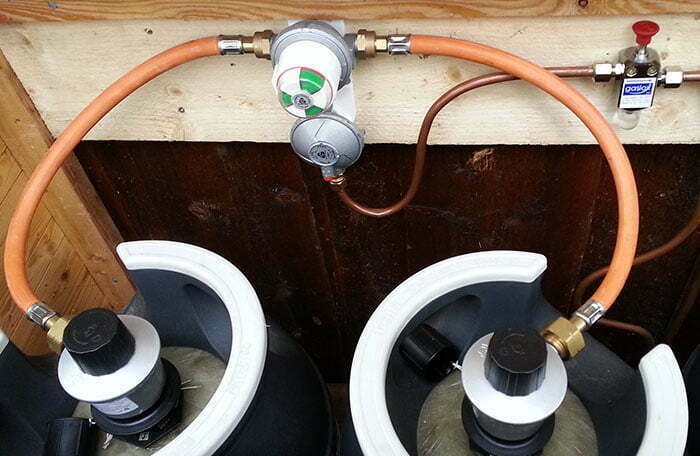
    • By the propane bottles there is a bottle selector:
      Green: Do nothing.
      Red: Replace the bottle that is empty and turn the arrow toward the bottle with the least amount left. Do not replace bottles that are not empty.
  • Changing propane bottles:
    Turn off the gas using the switch on the valve. The valve is loosened by lifting the black ring.
    Mount the new bottle by squeezing the black ring upward, pressing the regulator down onto the new bottle, and then pressing the black ring down to lock it.
    When the bottle is correctly mounted, it should be possible to lift the bottle by the regulator.
    Extra gas bottles are stored in the outbuilding.
    Bring empty gas bottles back across Åbjørvatnet and place them in the boathouse by the car.